FriendFace Feedback
15 Nov 2022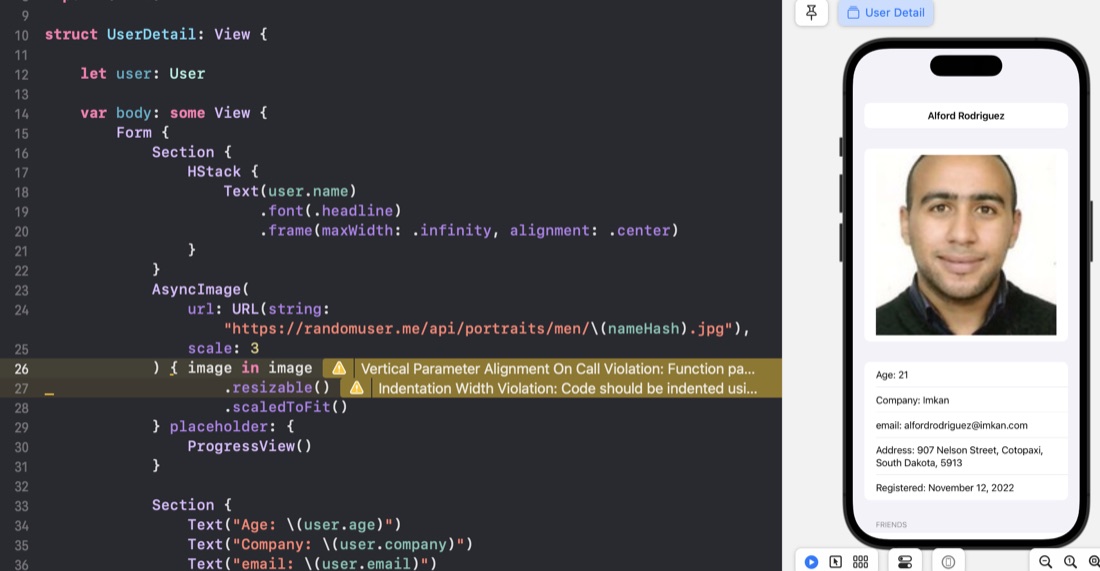
After each app, I use my HackingWithSwift+ membership to view Paul’s version of the app as a way to judge my performance. Yesterday’s app was “FriendFace ” - download some JSON of a number of people (including their friends) and display it.
UUID
In my struct, I’d just specified the User.id as a string, Paul uses UUID - this makes no difference to the app as it stands, but is much better if we ever needed to add users.
Example
For my details preview, I created a fake user in the preview. Paul does something slightly nicer - with a static let example = User(…) as a property of the User struct. Again - not a biggy for this app, but handy if you need to use it for other previews.
fetchUsers()
I had a test in the .task() to prevent the double loading of data, Paul puts his here inside a guard. I think mine is simpler to read and understand, but Paul’s would be better if there was a chance we might call fetchUsers() from other places in the app. If that’s likely, this would be the third time out of three differences where Paul is anticipating a bigger app - it might just be a reflex for such an accomplished developer. However, I’m going to award this one to me.
do/catch
Paul’s JSON fetching and decoding is in a single do/catch block - as mine was in my first drafting, but then it didn’t work correctly so I changed it. I think we can assume Paul’s works - he’s a quality coder, and this code has had a lot of eyes on it by now. So this is something I need to understand better.
Apart from the two items above, the rest of fetchUsers was essentially the same.
List
Paul used little red or green circles to indicate the active status of users in his list - much nicer than my version of having the text. Apart from that, it was a NavigationView iwht a List with a NavigationLink to the detail view, so same same.
UserDetails
Instead of a form, Paul uses a List with a .listStyle of .grouped which probably follows the HIG better.