Simple API endpoint in Go
27 Sept 2023
I’d like a small, quick, low load endpoint on all my nodes and VM’s that exposes a text keyword indicating if that machine is okay for RAM and disk space. I’m currently using Uptime Kuma to monitor if these machines are pingable, but I’d love a tiny bit more information from them so I’d get a Ntfy buzz on my phone if a machine is in trouble.
I mentioned a couple of weeks ago that the benefit of doing it in C rather than Node.js was probably not worth the trouble, but then being a fickle developer, decided to write it in Go.
This was a pretty sweet experience, it’s a nice language and the ecosystem is good. When writing such a small utility, you don’t really get a full appreciation for a language, but there is a couple of nice things going on - one I appreciated was that unused code - for example an import that’s not used, or a variable declared but not accessed is a compiler error and flagged by the intellisense as you type.
In terms of the language as written, it’s fair to say C-like - there’s no weirdness like the formatting being semantic. It’s statically typed, but has good inference.
The code is up on GitHub .
It’s hard-coded to port 10321 and the route is /vitals.

You get back this JSON. In my Uptime Kuma system, I search for the keywords mem_okay and disk_okay - no need to parse the JSON, it’s just an on/off status check that will show up in red on the page if there’s trouble, and ping my phone using ntfy.sh .
In Uptime Kuma, there’s an option when setting up a new monitor for Http(s) Keyword. How this works is that it will scrape that web address and look to see if a particular keyword exists. If the keyword is present on the page, that site is marked as up, if not, it’s marked as down.
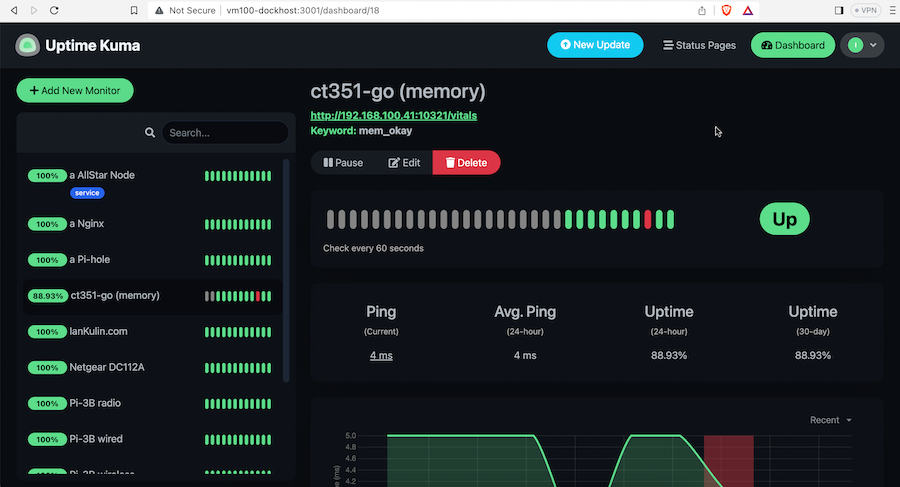
Testing the memory threshold for the screenshot above was fun:
stress-ng --vm-bytes $(awk '/MemAvailable/{printf "%d\n", $2 * 0.9;}' < /proc/meminfo)k --vm-keep -m 1