Aug. 28, 2023
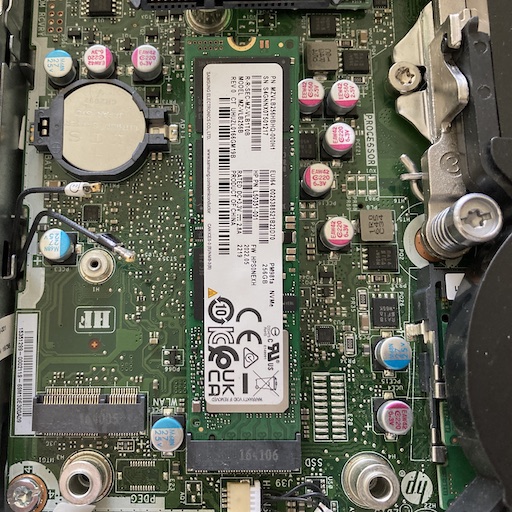
As part of my strategy to not worry about the slightly dodgy SMART reporting on the SDD’s in my HP Elitedesk G2 800 Mini Proxmox nodes, I’d decided to make use of the full sized M.2 slot to install 256GB NVME drives. That way I can boot from those, and have the SSD’s running ZFS which allows scrubbing to check the integrity of all the data. My VM disks can live on this drive.
May. 10, 2023
My MacBook died, I guess about three years ago. It was randomly difficult for a week or so, but then just behaving as if it had no hard drive at all. It’s been in a drawer ever since waiting for me to replace the hard drive and see if I could sell it, which I never quite got to.
I mentioned a while ago that I’d borrowed an old Atom powered HP Mini 110 to play with a Linux desktop machine, partly for fun & learning, and partly for a first-class SPICE experience (also fun). Meanwhile I’ve got an old but still sexy Intel MacBook Pro sitting in a drawer - that doesn’t make sense!
Apr. 27, 2023

A potential solution to my concern about the either perfect, or nearly dead, SSD would be to add a NVMe disk to the M.2 slot in the HP Elitedesk 800 G2’s. I’d use those to boot from and run Proxmox, then the existing SSD’s on each node in the cluster would just be part of the CephFS pool that has some redundancy built into it and hosts the VMs that are not using the NAS for their storage.
Apr. 25, 2023
I didn’t understand why the default Proxmox install sets up the storage the way it does - with the available disk split up into an LVM and an LVM thin storage - so I’ve been reading this excellent Proxmox Storage Guide by Programster (spoiler - the LVM thin makes VM snapshots easier).
At one point in the post they mention that you can see the “Wearout” percentage for any SSD drives in the Proxmox GUI, so of course, since I now own five second hand HP Elitedesk 800 G1/G2’s all with SSD drives, I dived in to have a look at each drive and found this.
Apr. 2, 2023

The hardware engineering of these corporate world mini-PCs is really nice. I swapped out the RAM today to bump my main machine up to 32GB from 16GB. It was a straightforward task - no screwdrivers, no drama.
To open the machine up, there is a single large screw on the back that can be undone with your fingers - it’s a captive screw, as in it doesn’t fall out - just another nice engineering thought.