Mar. 31, 2025
A large part of the reason for my use of Nginx Proxy manager over vanilla NGINX, is that it has built-in Let’s Encrypt certificate requesting and renewing. This works perfectly for all my public facing services, and until recently, my homelab services. Before I dive into how I’ve fixed the problem I ran into, I better explain how my homelab domain is set up, and before I do that, an over-simplified description of how the SSL system works is required
Nov. 25, 2024
I’ve been containerising my static websites with BusyBox (because it’s small), and in an earlier post showed how to even get the container to update parts of the site by reaching out with wget to download resources from elsewhere and saving them inside the container where we are serving the ‘static’ site from. I’d done this by including a bash script in the container with the wget in a loop with a sleep. Then started the script and the httpd server in the CMD line of the dockerfile.
Oct. 15, 2023

I’ve got a domain that’s not currently used, so I’m going to set it up as a virtual host under NGINX. This server is already serving two domains set up with Certbot for SSL. Is it going to be possible to add another site and have Certbot manage the certificates for it after I’ve run Certbot once?
When I googled around to find out, I didn’t find anything - which is usually a sign I’m either asking a wrong question, or it’s so little drama that no one ever mentions it. I decided just to move the site, check it was all working for the http version, then run Certbot and see what it said.
Oct. 12, 2023
I’ve been managing SSL certificates for my domains purchased from PorkBun by going there every 90 days downloading the certificates, joining them together to make the fullchain.pem then scp-ing them to my servers. That’s been sort of manageable, but less than ideal.
It also doesn’t work for my Australian domains. Since there’s strict rules about who can own a domain in the .au space (you have to have some sort of right to the name - a random person can’t obtain the coke.com.au domain unless that’s a trading name, a trademark, or something similar), they have to be managed by one of about eight organisations, and the offerings are much simpler.
Jul. 12, 2023

When I first installed my SSL certificates, I mentioned it’s a process I need to automate before they came up for expiry, but here we are ten days out, and I haven’t done that yet, but I have been keeping an eye on it though the excellent display and notifications set up in Uptime Kuma .
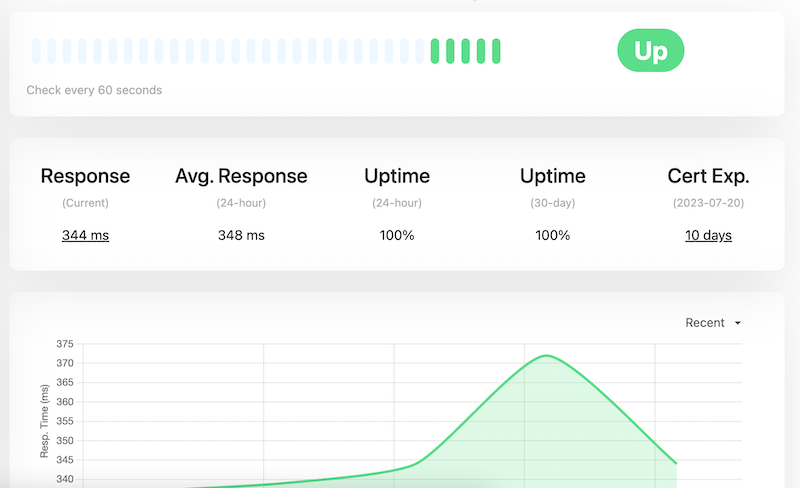
Updating the certificates is easy. When I went into the site at PorkBun (where I purchased the domain and who do the primary DNS for the site, the next certificates were sitting there to be downloaded. My existing certificates were due to expire on 30th July, and these had been generated on 3rd July.
Apr. 29, 2023

When you’ve successfully got Nginx running in a Docker container, AND got your domain correctly pointing at your nascent website, you’re then going to want to set it up for encrypted, and therefore trusted, browsing with SSL.
Certificates
A couple of posts ago, I mentioned that it was simpler to let Porkbun be the authoritative nameserver for a domain. Part of the reason for that is that if we do that, Porkbun had a button you can press which connects to LetsEncrypt and generates the certificates for you. This usually takes an hour or so, then you’ll be able to download the bundle from that same page.