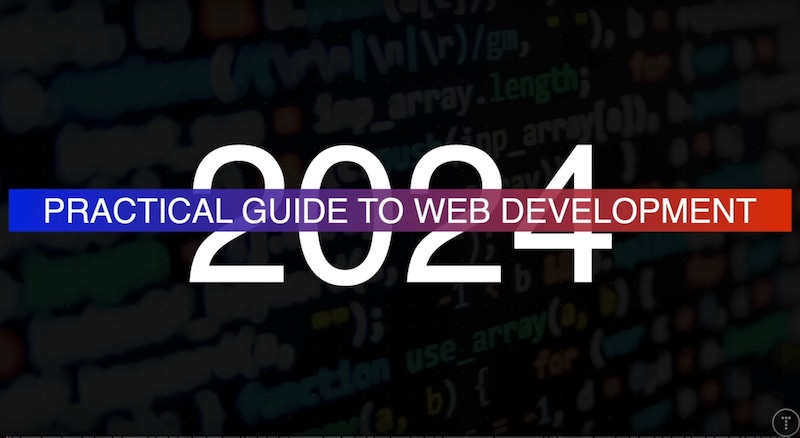
I don’t often just link to someone else’s content, but I was really impressed with Brad Traversy ’s “Web Development In 2024 - A Practical Guide” video. Apparently he does these every year - it’s just a really comprehensive overview of Web Development pitched at beginners.
I’ve been slammed with other work, so my web dev learning has fallen well behind. Luckily, the YouTube procrastination algorithm noticed this and suggested I watch a video from CodeWithCon titled Learn Backend in 10 MINUTES .
Since I was watching a video of a guy learning to land a C152 at St Baths (a skill I do not need) at the time, it was hard to argue with myself that I didn’t have ten minutes to learn all of backend programming.
I mentioned a couple of days ago that the ZTM webdev course was skipping forwards too quick and that it would need to be supplemented. For CSS, I think the supplement for me is going to be this series from Dave Gray.
On one of the more mediocre episodes of Fireside Swift , McSwiftface and Zach talk about the SOLID principles of class design, although I don’t hold the principles as the article of religious fervour that many interviewers apparently do, they are a useful touchstone for considering class quality. OOP had been in swing (in a commercial way) for a few years by then - I was writing in Delphi and C++. The spaghetti code era was a long way behind us and the idea of separation of responsibilities was well established.
The app I’m working on currently (for multiplication tables practice) has a number type keypad and display a bit like a calculator - but for entering the answers. It’s been quite fun to think through all the little problems to make it work how you’d expect, so I was quite interested to watch an iOS Academy video where Afraz Siddiqui builds a partially finished SwiftUI version of the iOS Calculator app.
I’ve started the habit of branching my code for each feature or batches of features. This is not really needed, I’ve developing solo, and the code on main is not in production. I could just go on committing, but part of my process is about becoming competent with git.
There are a couple of git commands (merge and rebase) that mush code between branches together in different ways. The video below (from Manuel Lorenz at Academind ) is a particularly clear look at these two commands.
A YouTube channel worth subscribing to is Afraz Siddiqui’siOS Academy . He does a great videos on iOS development. My favouriets might be the shorter focussed ones, like this one on the new SwiftUI chart views.
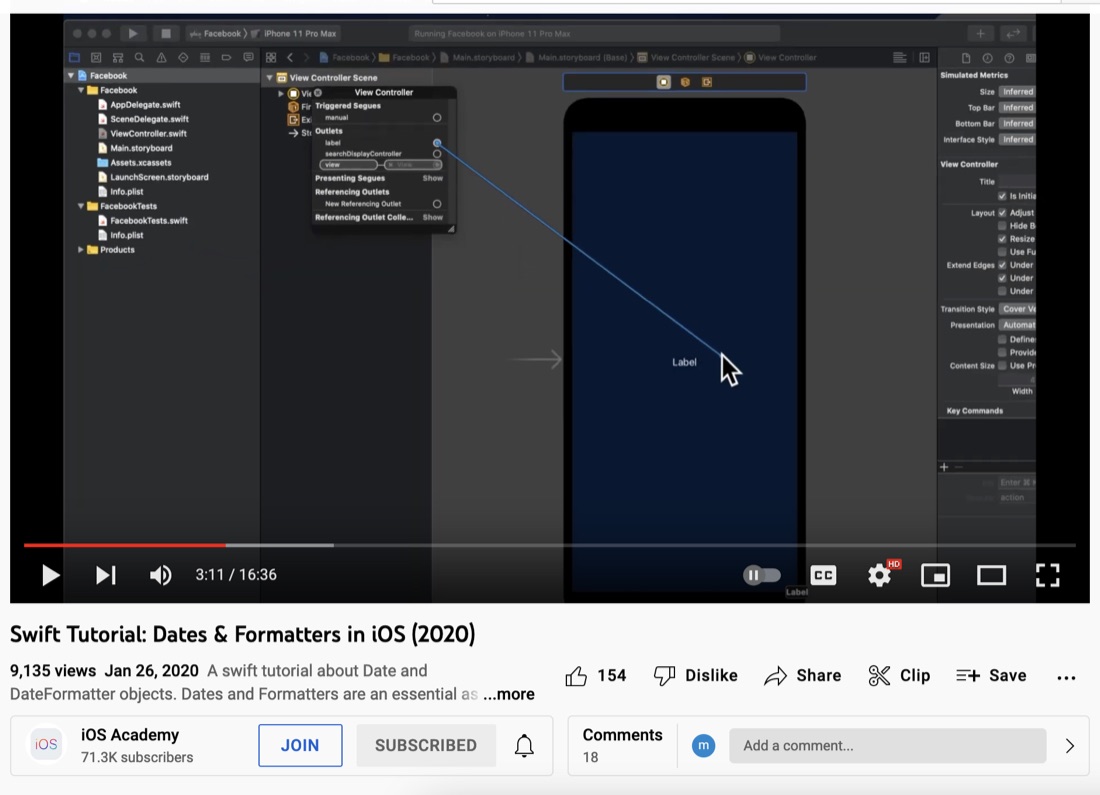
I’m on Day 26 of 100 Days, and didn’t grok the dates on my first read through, so I’ve read a couple of other explanations and sat down with a coffee and thought I’d see what YouTube had for me on the subject. I seen a few great iOS Academy videos, so this one seemed like a good choice.
I haven’t seen enough to say if it is a good or great explanation of dates, calendars and date components in Swift yet, but man, getting to the stage of writing useful code when using storyboards and UIKit takes a while! It’s literally 3:42 in to the video before there’s enough infrastructure done for “hello world”.
I’m still not 100% clear on @ObservedObject v @StateObject. So when YouTube offered up this video, in which Paul promises during the intro that I’ll understand the data bindings by the end, I thought it would be the video for me.
I guess I should really have twigged that I’d never heard of @ObjectBinding, but I pushed on to the 12 minute mark when he imports the Combine framework. Hang on, what’s that?
When I wrote my last commercial HTML (in 1996 lol) I’m pretty sure there was no CSS. It was the land of textured backgrounds, blinking scrolling text, “under construction” gifs, and links to gopher URLs were not uncommon. So this is an area I need to update my skills a little just to carry on a coherent conversation in the developer world.
I’ve bumped into a couple of Tech With Timvideos recently, and I really liked his CSS intro for “Non-web developers”.
I seem to consume a lot of iOS Academy videos with great, short (< 10 minute) explanations of various Swift iOS programming topics - particularly little UI topics, like this one on the Grid View.
I really appreciate the generous content provision in the Swift and iOS development community. Perhaps this is the same for lots of technologies, but for someone who started programming pre-internet, it’s a stark difference to how I used to learn - so many magazines, and so many 2" thick books.
The first nine minutes of this video from Emmanuel Okwara finally gave me a clear understanding of the difference between MVC and MVVM.
In both MVC and MVVM the data & logic (Model) are separated from the part that the user interacts (View). Usually the View is a screen with controls and so on, but that’s not compulsory - for example a voice mail app interface would be all audio and DTMF. The point is that in both, the user interface (view) does not mess directly with the data (model) - it has to go through some sort of gatekeeper.
If you need a solid tour of the basics plus of Xcode, this is a great video from Karin Prater. Its the first video in her “Design-oriented course on SwiftUI”.
One of my early goals was to get in the habit of using version control with Git/Github, and I’ve got that sorted out today. My source was this excellent, very clear video from Gwen Faraday . I highly recommend it if you are just starting.
It possibly helped that I’m also on mac, so I didn’t have to deal with the “or however that’s done on your system” type problems. Also, where things didn’t work as expected, the explanation about what was being done was clear enough that the problem was solvable. For example, the push command Gwen used was: